
MENU: Home | Catalog / Collection | About

My name is Tomás Custer. My father (Thomas C. Custer) created this amazing body of work. I have most of it (100+ highly detailed pieces) since he passed in 2019. It is an impressive collection that spans years of intensive work on his part. I hope he can be remembered for these. It consumed so much of his life and it has taken me a long time to organize and catalog his work after his death. I hope you enjoy.
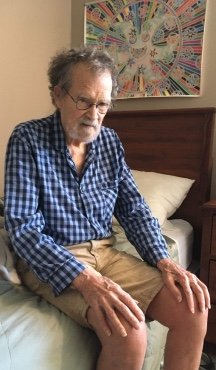
Born in 1937 in Chicago, my father (Thomas C. Custer) trained as an architect before venturing into art sometime in the 1980s. Regrettably, he was diagnosed with severe dementia and passed in a memory care unit in Portland, Oregon in 2019.
Most of his work was done on 18x24 sheets on paper using pen and ink, markers and sometime colored pencils. Clouds, skies, figures in passing, ordinary gatherings. Most pieces have the design inked onto mylar and some have the pencil sketches on mylar (usually both sides). The three phases can be seen in the image to the left of GVB 225 Split Unaware 2000. The top third is the pencil sketch, the middle third is the design in ink on mylar in a pointillist style (very light and hard to see in photo but I believe he moved away from the solid inked lines for a reason - after GVB 65 there are no more solid line designs on mylar) and finally the finished work. There are about 40 of these complete sets. All three phases of his creative process are amazing. View a few more sketches and a solid line inked mylar design at the bottom of the page.
Thomas C. Custer was a Chicago-born architect and visual artist who spent decades (late 1980s to ~2012) developing a body of work rooted in a single, quietly radical conviction: that the things we have learned to ignore are the things most worth our attention.
Trained at the University of Illinois at Navy Pier in the 1960s, he carried his architectural knowledge — and his architectural materials — into a parallel life as a theorist and artist. Beginning in the 1980s, he produced more than 180 original designs. The works are dense, luminous, and meticulous: stippled backgrounds, radiating forms, figures emerging from layered texture. Each one was developed through a precise multi-stage process — pencil studies on Mylar separating foreground from background, unified ink drawings rendered in mostly a pointillist style although earlier works had solid lines, and hand-colored prints finished over years with markers, ink and colored pencil.
He gave many of them names: Softy. Toughie. Crybaby. Sky Kids. Keepers. Don't Get Shakey. Goodness Gracious. Look at Looky. Not titles in the conventional sense — character names. A taxonomy of the overlooked. Sprysky is the name he gave their world.
This was intentional. Custer spent years developing a philosophical framework he called FUII — Functionless Unaware Indifference Imitation — which proposed that modern urban life produces a learned, unconscious indifference: people absorbing the blank detachment of those around them until other people, other faces, the ambient texture of daily life, recede into the background entirely. His paintings were designed as a counter-practice. GVB — Ground Valuing Behavior — names both the art and the intent: work that trains attention back toward what has been made invisible, without ever letting it become spectacle.
The figures in the paintings are not incidental to this theory. They are the argument. Custer was not painting skies. He was painting the strangers we have stopped seeing — and the act of naming them, numbering them, rendering them in meticulous detail across a body of work spanning at least three thousand pieces, was itself the practice he was describing.
Thomas C. Custer passed in 2019.
He coined the term FUII — Functionless Unaware Indifference Imitation. It’s his theory that in modern civilized society, people unconsciously imitate a kind of blank indifference toward others — not out of malice, but without even realizing they’re doing it. He saw this as a kind of social disease, spreading invisibly.
He defined two perceptual behaviors. GPB — Ground Perceptual Behavior — is the mental act of making something unimportant, pushing it to the background. FPB — Figural Perceptual Behavior — is the opposite, making something feel real and important. These come directly from Gestalt psychology’s figure/ground concept, which he knew well as an architect.
He called his own painting practice GVB — Ground Valuing Behavior. His art was literally the antidote to FUII. By making the background beautiful and worth attention, he believed exposure to his work could quietly reduce people’s unconscious indifference. So the stippled backgrounds, the radiating rays, the dense texture — those weren’t decorative choices. They were therapeutic by design.
ACE is a 24-page philosophical and psychological text, structured in three parts. It builds a speculative theory around a condition he calls FUII — Functionless Unaware Indifference Imitation.
It’s his theory that in modern civilized society, people unconsciously imitate a kind of blank indifference toward others — not out of malice, but without even realizing they’re doing it. He saw this as a kind of social disease, spreading invisibly.
ACE (A 'Civilized' Evil) 2004 (Draft) - This document is 24 pages, typed on typewriter with some handwritten comments
The text explicitly connects the GVB paintings (the Sprysky collection) to the theory. He defines his own artwork as Ground Valuing Behavior — art that values the unimportant without making it fully figure/recognizable — and proposes it as GVBT (Ground Valuing Behavior Therapy), a form of therapy deliverable through exposure to his art. The document's handwritten closing note reads: "YES FUNCTIONLESS UNAWARE INDIFFERENCE IMITATION IS AN INTANGIBLE... BUT REMEMBER THE VALUE THAT BEEN CREATED IN THE BIOLOGICAL, PHYSICAL SCIENCES AND CIVILIZATION BY THE DISCOVERERS OF CERTAIN INTANGIBLES."
Another document he wrote is an earlier, 11-page working draft written two years before ACE, composed across several dated sessions (August 15–23, 2002). This work is simply entitled FUII! (Link to PDF) The title page describes it as "a visual artist's unsuccessful attempt to make a reasonable hypothesis" — notably more self-deprecating than ACE.
It covers much of the same conceptual ground but in a more raw, personal form. The author recounts how his years in architecture and painting gradually led him to define his work as GVB, and how that definition eventually unlocked the FUII concept. The drafts show the idea actively evolving day to day. He surveys the same indirect evidence for FUII — homes, media, art — and catalogues many of the same objectless ills, while acknowledging openly that he cannot produce a proper empirical hypothesis, only a speculative one.
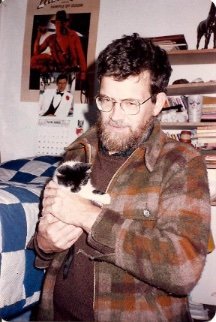
Dad in the 1980s
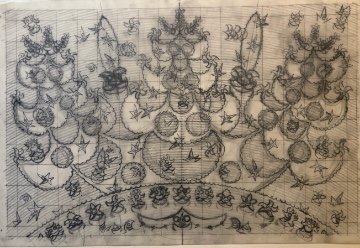
Sketch
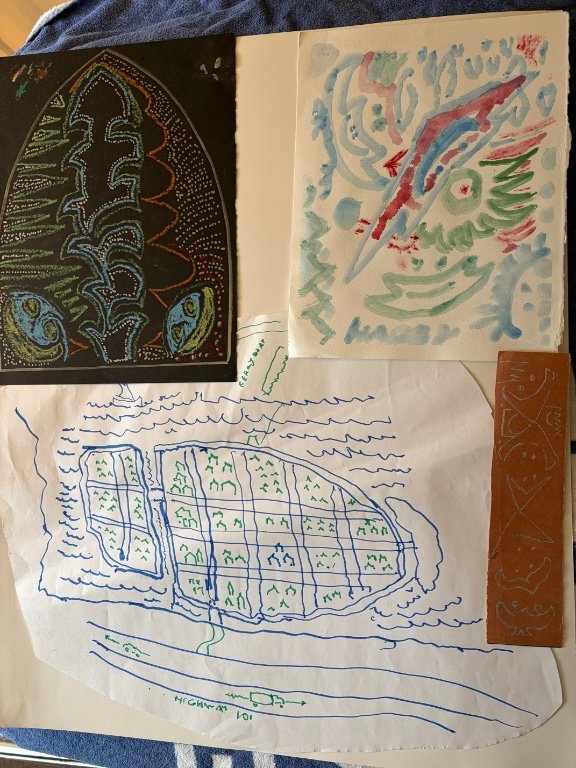
Final Drawings from the memory care unit. He was still drawing even with severe dementia in 2019. I collected these from the home he was in.
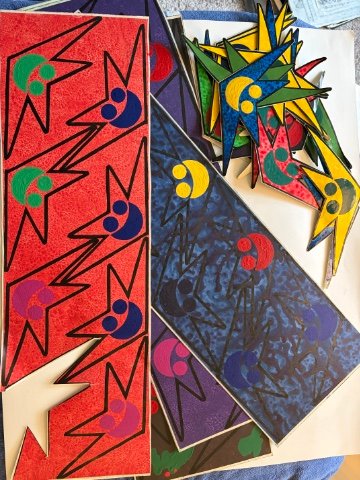
He had these bumperstickers made out of one of his characters. He cut them out and decorated his car with them. (I am looking for a photo of the car)
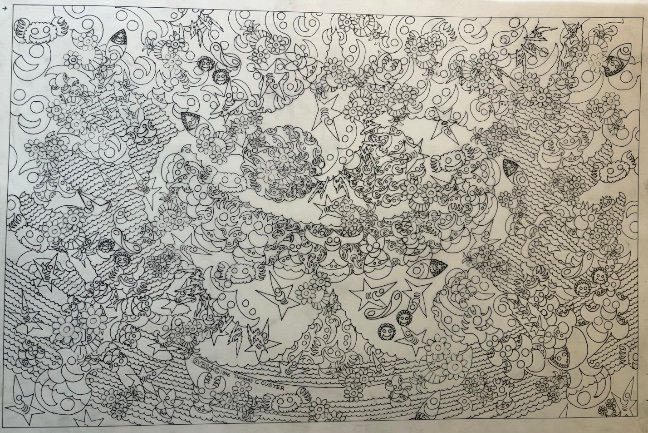
This is a solid-line inked mylar of GVB 24 1996. It is one of 6 designs at 12x18 and he never finished a color version.
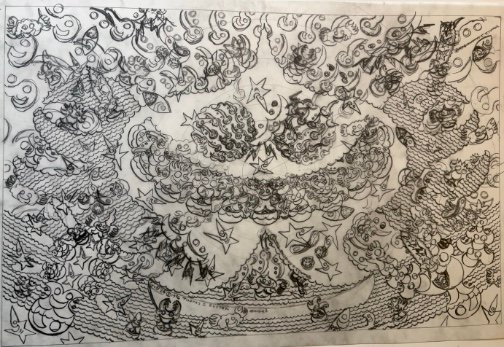
Here is the sketch of GVB 24